Crossing The Chasm: Why Most Breakthrough Ideas Never Reach the Mainstream

Why Do Many Innovative Products Disappear After Initial Success?
This question is clearly answered by Geoffrey Moore in one of the classics of the business and technology world — Crossing the Chasm.
The problem is not that the product is bad. The problem is that the market is not the same for everyone. Let’s first look at how technological innovations are adopted by people.
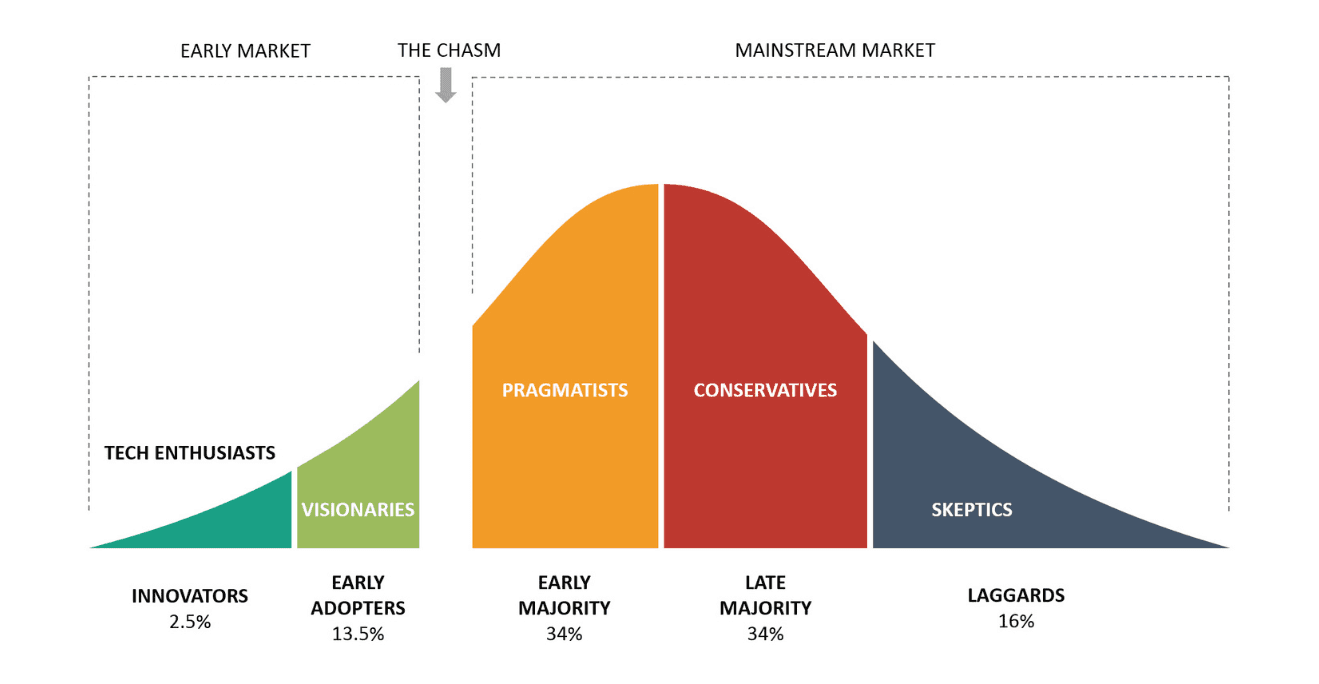
When an innovative product or service is launched, the first group to react are the Innovators — those who love trying new things first. They represent a very small group (around 2.5%), but their influence is high because they are often seen as experts. Next come the Early Adopters. These are visionaries who quickly understand new ideas, see their potential, and are willing to act on them.
After that comes a more pragmatic group — the Early Majority. Unlike early adopters, they prefer to wait, observe results, and only then decide. Once the product becomes widely accepted, the Late Majority follows. And finally, there are the Laggards — people who resist change and would never switch to a new product unless they absolutely have to.
Geoffrey Moore highlights a critical point within this sequence. There is a gap between Early Adopters and the Early Majority — precisely speaking between Early Market and Mainstream Market — and this gap is called the “Chasm.”
What does that mean? It means the product has already been validated by early users, but still fails to reach the mainstream market.
Why This Happens and How to Cross the Chasm
The main reason is surprisingly simple. Companies try to sell the same product, with the same message, to both early users and the mainstream market — assuming they behave the same way. They don’t.
Early Adopters are comfortable with uncertainty. They are driven by innovation, potential, and new ideas. The mainstream market, however, looks for stability, trust, and social proof. They don’t care about how innovative the technology is — they care about whether it works, reliably and consistently. Early adopters can tolerate bugs and imperfections. The mainstream market cannot. As Geoffrey Moore puts it: “Visionaries want to change the world. Pragmatists just want the world to work better.”
This is where many startups fail. They succeed in attracting early users. They generate initial excitement. But they fail to transition into the mainstream market. And that’s where growth stops.
The solution is simple — but often ignored. Don’t try to target the entire market at once. Instead, focus on a small, clearly defined segment. Win that segment. Build trust. Become the obvious choice there. Then expand. In simple terms: Don’t try to win everyone. Win one group — and let them take you to the rest.
Insights worth reading
Get fresh xSchool articles, expert opinions, and real marketing lessons, delivered straight to your inbox.
(Articles for You)

Habit Loop: How Habits Are Formed and How They Can Be Changed
Some ideas explain behavior so clearly that once you see them, you can’t unsee them. The Habit Loop is one of those ideas.

Black Box Thinking: Why Progress Starts With Owning Mistakes
From time to time, I come across ideas in books that don’t just sound smart — they change the way you look at systems, leadership, and culture. Black Box Thinking is one of those ideas.
(Your Next Step Starts Here)
Welcome To Leadership
Leave your details to explore the right program, format, and timing for your leadership journey.